
Last Updated: November 3, 2026
Quick Summary
To avoid tourist traps in 2026, run a five-minute test before paying: check whether the crowd is all one-time visitors, confirm the all-in total in writing, and look for repeat-customer signals like loyalty cards or staff greeting regulars by name. Read two- and three-star reviews first, and walk two blocks off the main strip to compare prices and service.
- A tourist trap relies on one-time visitors, high foot traffic, and location rather than repeat customers and quality.
- Read the two-star and three-star reviews first because they are more specific than five-star praise.
- Ask for the all-in total in writing, including tax, fees, and required add-ons, before you pay.
- Walk two blocks off the main strip and compare what the same category of business charges there.
- Go at opening or in the last two hours before closing, when queues are shortest.
Table of Contents
- Why Tourist Traps Still Catch Travelers in 2026
- How to Spot a Tourist Trap Before You Pay
- How to Research Tours and Attractions Without Wasting Hours
- How to Avoid Tourist Trap Restaurants and Find Where Locals Eat
- Alternatives to Popular Tourist Attractions: Finding Hidden Gems
- Avoiding Crowds and Peak Visiting Times at Famous Attractions
- Scams, Aggressive Selling, and Tourist-Targeted Pricing
- A Step-by-Step Decision Checklist for Any Destination
- Planning Your Orange County Stay and Booking with Confidence
- Frequently Asked Questions
Why Tourist Traps Still Catch Travelers in 2026
Tourist traps still catch travelers in 2026 because the internet made them look better, not worse. Paid placement, polished review profiles, and social feeds full of the same photo convince visitors that crowded equals good. This guide covers how to avoid tourist traps in 2026 with a simple, repeatable system.
The good news: the tools to see through the noise are free. The bad news: most people only use them after they have already paid.
Here is the pattern we see again and again. A traveler lands, opens a maps app, taps the highest-rated pin near the hotel, and walks in. That pin is often the one place every other visitor also tapped.
Below, we break down a five-minute warning-sign test, a research routine that takes minutes instead of hours, and a decision checklist you can run in any destination. But first, here is what most guides get wrong: they tell you to “avoid tourist traps” without defining one.
A tourist trap is a business or attraction that relies on one-time visitors, high foot traffic, and location rather than repeat customers and quality. That definition matters because it tells you where to look for warning signs: pricing, reviews, and how the place treats people who will never come back.
Federal Trade Commission consumer advice on travel scams
How to Spot a Tourist Trap Before You Pay
Spotting a tourist trap before you pay comes down to a repeatable three-part test: who is in the crowd, how the price is presented, and whether the business shows any sign of relying on repeat customers. Run all three before you hand over a card, and you will catch most traps in under five minutes.
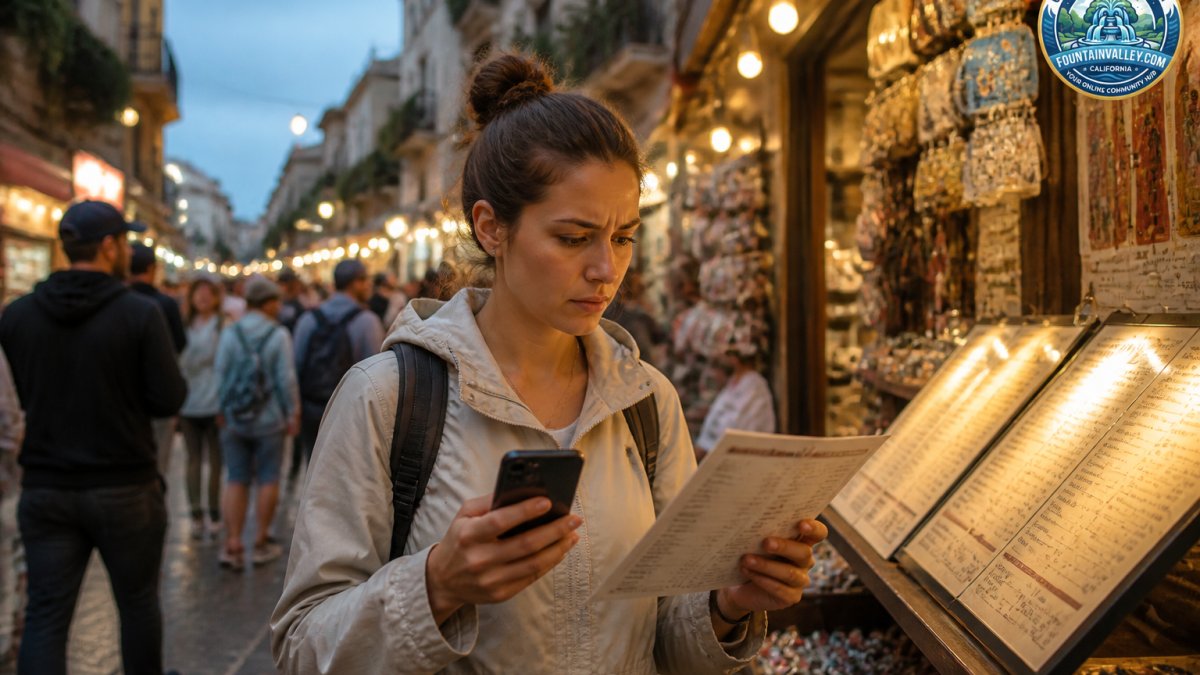
Start with the crowd. A line made entirely of out-of-towners with cameras is a warning sign, not a guarantee of quality. So is a host who waves you in from the sidewalk. The useful question is not “is it busy?” but “who is busy here?” If you see no one who looks like a local, someone picking up a to-go order, a regular greeted by name, a delivery driver who knows the back entrance, treat that as a signal to slow down.
Then look at the price. Menus and ticket boards with no prices listed are a red flag. So are “starting at” prices that balloon once you are inside. The mechanism to watch for is the add-on stack: a base ticket price that excludes a service fee, a processing fee, a facility fee, a photo package, or a mandatory gratuity. A common pattern in heavy tourist areas is a posted price that is noticeably lower than what you actually pay at checkout. Before you commit, ask for the all-in total in writing, ticket, tax, fees, and any required add-ons, and compare that number, not the headline price, against alternatives.
The woman is American.
Finally, check for the repeat-customer signal. A business that depends on one-time visitors can afford to treat you as a transaction. A business that depends on locals cannot. Look for a posted weekly special, a loyalty card, a bulletin board with neighborhood notices, or staff who greet people by name. None of these guarantees quality, but their absence in a high-traffic area is telling.
Warning Signs That Show Up in the First Five Minutes
- Staff push a photo package before you even ask a question
- The menu has photos of every dish and no local language on it
- Prices are listed in large round numbers with no tax or fees shown
- Every review on the wall is from the same month
- Nobody behind the counter seems to know a regular by name
- A “free” sample or gift requires you to step inside and sit down
- The entrance is designed so you must pass through a gift shop to exit
Watch out: the biggest mistake is treating a long line as proof of quality. In heavy tourist areas, the line is often the product. People join it because other people joined it. A better test is to walk two blocks off the main strip and compare what the same category of business charges and how it treats customers there. If the price drops sharply and the service improves, the first place was likely charging for location, not quality.
How to Tell a Worthwhile Popular Attraction from a Trap
Popularity alone does not make a trap. Some famous sites earn their crowds because they offer something you cannot get elsewhere, a specific view, a piece of history, a performance, or a natural feature. The difference is whether the place gives you something to do once you arrive, or just something to photograph.
Use three questions to decide whether a famous attraction is worth the cost:
- What do I get for the ticket? A guided interpretation, a timed entry to a specific exhibit, or access to a site with no substitute is different from a photo opportunity you could get from the street.
- What is the all-in cost per hour? Divide the total price by the time you will realistically spend there. A landmark that costs a little and fills three hours is a better value than a cheap photo stop that takes fifteen minutes.
- Is there a free or lower-cost alternative that delivers most of the experience? Many famous sites can be seen from a public viewpoint, a nearby park, or a free walking route. Paying for the interior is worth it only if the interior is the point.
A worthwhile landmark usually earns its fame. A trap borrows it. When a famous site passes these three questions, book it with confidence and move on to the next decision.
How to Research Tours and Attractions Without Wasting Hours
Research tours and attractions in three passes: a map scan, a review check, and a quick search for local voices. For a practical walkthrough of vetting and booking legitimate local tours, see this guide to booking local tours in Orange County. The whole routine takes about twenty minutes per destination, not an evening.
Pass one: the map scan. Open a maps app and look at the pins around your hotel. Then zoom out and look at the pins a fifteen-minute walk away. The cluster near the hotel is where the trap density is highest.
Pass two: the review check. Read the two-star and three-star reviews first. They are more specific than the five-star ones and they tell you what actually goes wrong.
Pass three: local voices. Search travel forums and neighborhood groups for the name of the area, not the name of the attraction. Locals talk about areas. Tourists talk about landmarks.
Reading Reviews and Ratings Critically
Read the middle reviews, not the extremes. A wall of five-star reviews with short, generic praise is a warning sign. So is a sudden burst of reviews in one week.
Look for reviews that mention specific details: a dish, a guide’s name, a wait time, a fee. Specific reviews are hard to fake at scale.
Also check the dates. A place that peaked two years ago may still carry a high rating while the experience has slipped. Recent reviews tell you what you will actually get.
How to Avoid Tourist Trap Restaurants and Find Where Locals Eat
Avoid tourist trap restaurants by eating where the menu is short, the prices are posted, and the customers are not all holding guidebooks. The single best signal is a menu written for people who live nearby. If you would rather let a guide handle it, you can book guided local food tours online that take you to authentic spots.
Book Hotels with Exclusive Discounted Rates HERE →
Here is how we would do it in practice:
- Walk two blocks off the main strip in any direction
- Look for a posted menu with prices and no photos
- Check whether the staff greet people by name
- Look at what is on the tables, not what is on the sign
- Search the restaurant name plus the neighborhood, not the landmark
Checking Menus, Fees, and Add-Ons Before You Sit Down
Ask three questions before you order: Is tax included? Is there a service charge? What does the “market price” actually mean today?
These add-ons are where the real cost hides. A posted price that grows by the time the check arrives is a classic tourist-area move.
Watch out: a host who will not let you see a menu before seating you is telling you something. Walk away.
Alternatives to Popular Tourist Attractions: Finding Hidden Gems
Hidden gems are rarely secret. When you are ready to skip the traps, you can browse and buy attraction tickets for legitimate local attractions. They are simply places that do not spend money on promotion. Finding them means searching by interest, not by ranking.
Try these approaches:
- Search for the activity, not the attraction (“kayaking” rather than “the famous bay”)
- Look at state and city park listings, which rarely pay for placement
- Ask at a locally owned shop, not a hotel concierge desk
- Check what is open on a weekday morning, when crowds are thinnest
- Follow local photographers and runners, not travel influencers
A worthwhile landmark usually earns its fame. A trap borrows it. The difference is whether the place gives you something to do once you arrive, or just something to photograph.
Avoiding Crowds and Peak Visiting Times at Famous Attractions
Crowds follow a predictable clock, and you can plan around it. Famous attractions are busiest mid-morning through mid-afternoon, and on weekends and school breaks.
The fix is simple:
- Go at opening, when queues are shortest
- Go in the last two hours before closing
- Pick a weekday over a weekend
- Book timed entry in advance when a site offers it
- Save the indoor museum for the hottest part of the day
Shoulder season matters too. Crowds often thin outside peak travel weeks.
Scams, Aggressive Selling, and Tourist-Targeted Pricing
Scams aimed at visitors share a pattern: pressure, confusion, and a price that appears late. The FTC’s guidance on travel and timeshare scams describes the same playbook again and again.
Common versions include:
- A “free” gift that requires a deposit or a sales presentation
- A taxi or ride that quotes one price and charges another
- A tour that collects cash and never departs
- A menu with no prices, followed by an inflated bill
- Street sellers who quote a price per item, then charge per unit
Defend yourself with three habits. Confirm the total price in writing before you pay. Pay by card when you can, so you have a record. And walk away from any deal that only works if you decide right now.
Consumer Sentinel Network data on fraud reports
A Step-by-Step Decision Checklist for Any Destination
Run this checklist before you book anything, anywhere. It works for a restaurant, a tour, a museum, or a rental.
| Step | Question to Ask | Red Flag | What to Do |
|---|---|---|---|
| 1 | Is the total price posted? | No price shown | Ask for the full total first |
| 2 | Who else is here? | Only one-time visitors | Walk two blocks and compare |
| 3 | What do mid-tier reviews say? | Vague, recent, repetitive | Read the 2 and 3 star reviews |
| 4 | Are fees and tax included? | Add-ons at checkout | Confirm before you pay |
| 5 | Is there pressure to decide? | “Only today” offers | Walk away and think |
| 6 | Do locals mention this area? | No local voices | Search the neighborhood |
| 7 | Can I get a refund? | No written policy | Get the terms in writing |
Two extra checks cover different travel styles. Families should confirm stroller access and restroom locations before committing to a long tour. Travelers with mobility needs should call ahead rather than trust a listing. Solo travelers should share their route with someone and keep cash split in two places.
Planning Your Orange County Stay and Booking with Confidence
Booking with confidence means choosing a base that puts you near what you came to see, then locking in the details before you arrive.
Start with where you sleep. A trusted hotel directory helps you compare options and book your stay in advance.
Then plan the days around your base, not around the map. If you prefer self-catering, browse vacation rentals as an alternative to tourist-heavy hotels. Group nearby stops together, book timed entries early, and leave one flexible afternoon for the places you discover on the ground.
That is the real defense against tourist traps: a plan flexible enough to walk away from a bad deal.
Frequently Asked Questions
How can I tell if something is a tourist trap before I book it?
Look for a few consistent signals: prices that sit far above nearby comparable options, menus or tickets with no itemized breakdown, reviews that praise the setting but not the experience, and staff who push add-ons before you have decided anything. Read the two-star and three-star reviews first, since they tend to describe specific problems rather than general enthusiasm. If a listing hides its full price until checkout, treat that as a reason to slow down rather than a convenience.
How do I avoid tourist trap restaurants when I don’t know the area?
Walk two or three blocks away from the main attraction or beachfront strip and compare menus before choosing. Restaurants with photo-heavy menus in five languages, staff standing outside waving people in, and no posted prices are the ones to steer clear of. Search local neighborhood names rather than landmark names, and check whether reviewers mention returning or living nearby. A short drive to a suburban dining district often costs less and delivers better food than the closest option to a famous site.
What are good alternatives to popular tourist attractions?
Start with what the popular site actually gives you, then look for the same experience at a smaller scale. If you want scenery, try a regional park or a lesser-known stretch of coastline. If you want culture, look for neighborhood markets, community events, or small museums instead of the headline venue. Local recommendations from residents, library event boards, and community forums often surface options that never appear on a top-ten list, and they usually come with fewer crowds and lower entry costs.
How do I check whether a tour is worth booking?
Confirm what the price includes before you pay: entry fees, equipment, transportation, and gratuity are the usual gaps. Check the group size, since large groups reduce what you actually see. Look for a stated cancellation policy and a real business address. Then read reviews for comments about pacing, guide knowledge, and whether the itinerary matched the description. Tours that answer these questions up front are generally the ones that deliver what they promise.
The best trips are built on a little skepticism and a good base. Fountain Valley is building a guide to help you plan exactly that kind of trip, with local context on where to stay, what to book, and which spots are worth your time. Check back as we add more, and start with the hotel and rental listings to lock in your stay before the good options fill up.