
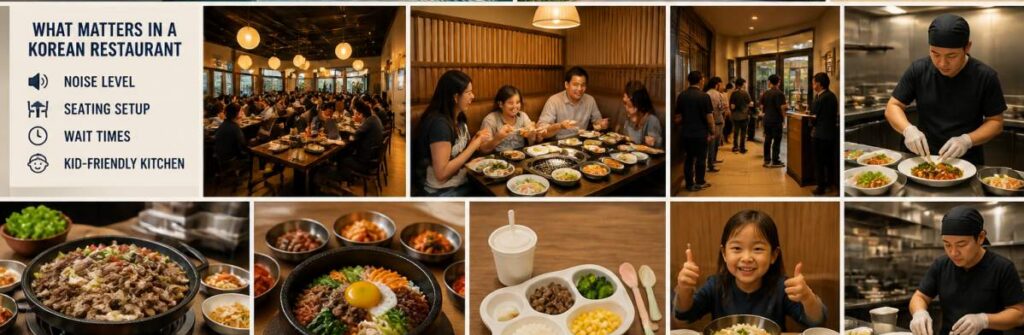
How to Compare Family Friendly Korean Restaurants
Comparing family friendly Korean restaurants comes down to four things: noise level, seating setup, wait times, and how the kitchen handles kids. Get those right and dinner works. Get them wrong and you’re eating cold bulgogi in the car. This guide breaks down what actually matters, dish by dish and table by table.
Korean food is one of the great family cuisines. Most of it arrives at the table already divided into small portions, which suits children who refuse to commit to a full plate. The catch is that most Korean restaurants were not designed with strollers, booster seats, or a four-year-old’s spice tolerance in mind.
That’s the tension running through this whole guide: Korean dining is built for groups, but not necessarily for small people. Below, we’ll show you exactly how to read a restaurant before you commit, which dishes reliably land with picky eaters, and how to handle allergies, accessibility, and budget without turning dinner into a project.
Key Factors: Noise Level, Seating, and Wait Times
Noise level, seating, and wait times decide whether a Korean restaurant works for your family far more than the food does. A restaurant can serve the best jjajangmyun in the area and still be unusable at 6 p.m. on a Saturday with a toddler.
Here’s what to check before you go:
| Factor | What to Look For | Why It Matters |
|---|---|---|
| Noise level | Busy, chatty rooms beat quiet ones | Kids can be loud without stares |
| Seating | Booths, high chairs, floor tables | Booths contain spills and wiggles |
| Wait times | Off-peak arrival, call-ahead | Hungry kids do not queue well |
| Table type | Built-in grill vs. standard | Grills need constant adult attention |
| Banchan pace | Refills offered freely | Free refills keep kids busy |
A common mistake is booking the trendiest spot in town. Loud, packed rooms are actually better for families than hushed ones, because nobody notices a dropped spoon. What most guides miss is that a restaurant with a waitlist and no lobby seating is a harder sell than one with a slightly duller menu and immediate tables.
Kid Friendly Korean BBQ: What Parents Need to Know
Kid friendly Korean BBQ works well for families once you understand one rule: the grill belongs to an adult, always. Children eat the banchan, the rice, and the pre-grilled meat. They do not reach across a hot surface, and they do not sit on the aisle side of it.

The communal dining format is the real draw. Everyone shares, everyone reaches, and nobody has to finish a plate they didn’t choose. For picky eaters, that’s a gift: they can try one bite of five things instead of committing to one.
Grill Safety and Communal Dining with Children
Grill safety comes down to seating position and supervision, not avoidance. Ask for the child to sit on the inside of the booth, away from the grill edge and away from the walking path where servers carry hot plates.
Order grilled items early. Bulgogi and other marinated meat cook fast, and once the meat is off the grill, you can switch the heat down or off entirely and relax. Marinated meat also tends to be soy-based and savory rather than spicy, which makes it one of the safest bets for kids at a Korean BBQ table.
Mild Korean Dishes for Toddlers and Picky Eaters
Mild Korean dishes for toddlers center on steamed, egg-based, and soy-sauce preparations rather than anything built on chili paste. Gyeran-jim, a steamed egg dish, is soft, savory, and almost universally accepted by small children. Kimbap, rice and fillings rolled in seaweed, works like a sandwich and travels well.
Here are the dishes that consistently land with kids:
- Gyeran-jim – steamed egg, soft texture, no spice
- Kimbap – rice rolls, easy to hold, mild fillings
- Bulgogi – marinated meat, sweet-savory, not hot
- Jjajangmyun – black bean noodles, mild and slightly sweet
- Tang-su-yuk – sweet and sour pork, a reliable crowd-pleaser
- Steamed rice and plain banchan – the fallback that always works
The dishes to approach carefully are anything described as kimchi-based, anything with gochujang in the name, and anything labeled spicy on the menu. Spice level in Korean cooking is adjustable at some restaurants and fixed at others, so ask before you order rather than after.
Korean Restaurant Dining Tips for Parents
Korean restaurant dining tips for parents start with timing. Arrive before the rush, order within the first five minutes, and ask for rice and a mild banchan to hit the table immediately. A child with something to eat is a child who waits patiently for the rest.
Chopstick training is worth starting at the table rather than at home. Most Korean restaurants will bring a fork or spoon without hesitation, so there’s no reason to force chopsticks before your child is ready. Let them try, keep the backup utensil nearby, and don’t make it a test.
Ordering Without a Kids’ Menu
Most Korean restaurants don’t print a kids’ menu, and that’s not a problem once you know how to order. You’re building a child’s plate out of the regular menu, and the regular menu is unusually well suited to it.
Order this way:
- One mild protein, such as bulgogi or tang-su-yuk
- One noodle or rice dish, such as jjajangmyun or kimbap
- One steamed dish, such as gyeran-jim
- Rice for the table
- A banchan or two you know your child will eat
That combination feeds two adults and two children comfortably at most Korean restaurants, and it lets everyone share. If your child is a genuinely picky eater, order the noodles and the steamed egg first and let the adults fill in around them.
Allergy and Dietary Restriction Guide for Korean Dining
Allergies and dietary restrictions are the area where Korean dining needs the most care, because soy, sesame, egg, wheat, and shellfish appear across the menu in places you wouldn’t expect. Soy sauce shows up in marinades, banchan, and dipping sauces. Sesame oil and sesame seeds garnish almost everything. A dish that reads as plain grilled meat on the menu may still arrive brushed with a soy-based glaze.
Most guides stop at “tell your server about allergies.” That advice is not enough when the allergen is in the banchan that arrives unrequested. Here is what actually works.
Where the Common Allergens Hide
| Allergen | Common Hidden Sources | Safer Ordering Path |
|---|---|---|
| Soy | Marinades, banchan, dipping sauces, soup bases, some noodles | Unmarinated grilled meat, plain steamed rice, ask for salt-only seasoning |
| Sesame | Garnish on rice and banchan, dressings, some marinades | Request no sesame garnish; ask which banchan are dressed |
| Egg | Gyeran-jim, some noodles, some fried items, binders in patties | Skip gyeran-jim if egg is the concern; ask about binders |
| Wheat | Noodles, dumplings, some sauces, some marinades | Rice-based dishes, plain grilled meat, steamed vegetables |
| Shellfish | Some banchan, some broths, some kimchi preparations | Ask specifically about broth bases and banchan |
How to Talk to the Kitchen
A common pattern is that front-of-house staff know the menu but not every ingredient in every banchan. Ask two questions: “Which dishes contain [allergen]?” and “Can this be made without it?” If the answer to the second is uncertain, treat the dish as unsafe rather than risk it.
For serious allergies, call during a quiet hour before you visit and ask to speak with a manager or kitchen lead. Ask directly: “Do you use the same fryer, grill, or prep surface for [allergen] and for other dishes?” Cross-contact is a real consideration in busy kitchens, and the honest answer at many restaurants is yes. If a reaction would be serious, that answer should change your plan, not just your order.
Building a Safe Order
For gluten-free diners, the practical path is grilled meat without marinade, plain steamed rice, and simple vegetable banchan, ordered explicitly. For soy-free diners, ask whether the kitchen can season with salt and sesame oil only, many can, but not all will. For shellfish allergies, ask about broth bases before ordering any soup or stew.
A short script helps: “We have a [allergen] allergy at the table. Can you tell me which of these dishes are safe, and can the kitchen prepare them without cross-contact?” Restaurants that take this seriously will answer clearly. Restaurants that wave it off are telling you something useful.
Dietary Restrictions Beyond Allergies
Vegetarian diners face a specific challenge: many banchan and soups use fish sauce, anchovy stock, or meat broth even when the dish looks vegetable-based. Ask whether the kimchi and the banchan are vegetarian, and whether the soup base is anchovy or meat stock. Some restaurants can substitute, and some cannot.
If you are planning a longer trip around meals like these, it helps to line up the rest of the day too, quiet places to stay, nearby activities, and tickets for tours or events, so a single difficult dinner does not derail the whole visit.
Accessibility and Amenities at Family Friendly Korean Restaurants
Accessibility and amenities are the most overlooked part of choosing a Korean restaurant, and they’re often the deciding factor. A restaurant can be perfect on paper and still fail if there’s no room for a stroller or no accessible restroom. Most guides mention high chairs and stop there. The practical details matter more.
What to Verify Before You Go
Ask about these before you commit, and ask specifically:
- Step-free entry and doorway width, Can a stroller or wheelchair pass without being folded or lifted?
- Accessible restroom, Is there a stall with grab bars and a turning radius, or only a standard restroom?
- High chairs and booster seats, How many are on hand, and are they cleaned between uses?
- Space between tables, Can a stroller park beside the table without blocking a server path?
- Parking proximity, How far is the walk from the lot or street to the door?
- Changing table, Is there one in the restroom, and is it in the accessible stall or a separate space?
A two-minute phone call during a quiet hour answers most of these. Ask the host, not the reservation line, when possible, the host sees the room every shift.
Floor Seating and Mobility
Traditional floor seating, where guests sit on cushions at low tables, is common at some Korean restaurants and genuinely difficult with a toddler or a mobility aid. Getting up and down from the floor with a child in your arms is a real safety issue, and low tables put hot dishes within easy reach of small hands.
Ask for a standard table when you book. Most restaurants offer both, and the request is routine. If the restaurant only has floor seating, that is useful information before you arrive, not after.
Strollers, Car Seats, and Gear
Stroller storage is rarely advertised but almost always solvable. Ask whether the stroller can park beside the table, at the host stand, or in a designated area. Restaurants with tight table spacing may ask you to fold it, so a compact stroller is easier than a full-size one in authentic Korean establishments.
Car seats are trickier. Most Korean restaurants do not have sling-style infant seats, so plan to bring your own or hold the child. Booster seats are more common than high chairs at some establishments, so confirm which one is available if your child needs a specific type.
Noise, Lighting, and Sensory Considerations
Families with sensory-sensitive children should ask about two more things: lighting and background music. Some Korean BBQ rooms are bright and loud, which works for many kids but overwhelms others. A quieter corner table, requested at booking, often solves it.
If your child needs a calm environment, aim for off-peak hours, mid-afternoon or early evening, when the room is less full and the kitchen is less rushed. The same table that feels chaotic at 7 p.m. on a Saturday can feel manageable at 4:30 p.m. on a Tuesday.
Planning Around the Meal
If you are building a longer trip around meals like these, it helps to plan the rest of the day too. Nearby parks, quiet activities, and places to stay within a short drive of the restaurant make a family outing feel less like a logistics exercise. Lining up hotel booking, vacation rentals, and tickets for tours or events in advance means a single difficult restaurant does not derail the whole day. Much of our revenue comes from hotel bookings, vacation rentals, and ticket sales for tours and events, so we would like to see links to those.
Budget-Friendly vs. Premium Korean Dining for Families
Budget-friendly and premium Korean dining differ less in food quality than in space, service, and pacing. The affordable end of the spectrum usually means faster turnover, louder rooms, and simpler banchan. The premium end means more room between tables, more attentive service, and often a private room option.
For families, the value calculation is different from a date-night calculation. You’re paying for room to move and patience from staff, not for a tasting menu.
| Consideration | Budget-Friendly | Premium |
|---|---|---|
| Table spacing | Tight, lively | Roomy, calmer |
| Banchan refills | Usually free | Usually free |
| Private rooms | Rare | Often available |
| Pace | Fast | Relaxed |
| Best for | Quick family meals | Celebrations, groups |
Pricing at any Korean restaurant depends on the dishes ordered, the number of diners, and the day of the week, so check with the restaurant directly for current menu prices rather than relying on an old listing.
If you’re building a longer trip around meals like these, it helps to plan the rest of the day too. Fountain Valley‘s local guides cover nearby parks, activities, and quiet places to stay, and the team is building out hotel booking, vacation rental, and tour and event ticket resources so you can put the whole trip together in one place.
Conclusion
The hardest part of Korean dining with kids isn’t the food. It’s the logistics: finding a table with room to move, a dish mild enough for a toddler, and a kitchen that will tell you honestly what’s in the banchan. That’s a planning problem, not a cooking problem, and it’s solvable with one phone call and a short list of dishes.
Fountain Valley is building exactly that kind of resource for families, solo travelers, and couples exploring the area’s dining scene, with local guides alongside hotel booking, vacation rentals, and tickets for tours and events. Check back as the guide fills out, and start with the quiet, roomy restaurants first. They’re the ones that make a family dinner feel easy.
Frequently Asked Questions
What are the best Korean dishes for children who are picky eaters?
Mild options like gyeran-jim (steamed egg), kimbap (seaweed rice rolls), and plain bulgogi work well for picky eaters. These dishes are savory, not spicy, and have familiar textures. Tang-su-yuk (sweet and sour pork) and jjajangmyun (black bean noodles) are also kid favorites. Ask for sauces on the side so children can control what they eat.
Are Korean BBQ restaurants safe for young children?
Yes, with supervision. The grill is hot, so seat children away from the edge and ask staff to cook meat for you if possible. Many family friendly Korean restaurants provide high chairs and have staff who can grill at the table. Keep toddlers in a booster or high chair and never let them reach across the grill. Communal dining means sharing, so watch for hot pots and pans.
Which Korean side dishes are mild enough for kids?
Banchan like steamed egg, potato salad, fish cake, and plain rice are mild. Avoid kimchi and spicy radish. Gyeran-jim is a safe bet. Many restaurants offer mild versions of cucumber or spinach. Always taste before giving to toddlers, as some side dishes contain sesame or soy.
How do I know if a Korean restaurant is suitable for families?
Look for high chairs, kids’ menus, and a relaxed noise level. Check online reviews for mentions of family-friendly service. Call ahead to ask about seating capacity and wait times. Restaurants with booths or private rooms are easier for families. Also ask about allergen accommodations and whether they can adjust spice levels for mild Korean dishes for toddlers.