Table of Contents
- Why Guide Accuracy Matters for Your Trip
- How to Evaluate a Source’s Credibility
- Verify Information With Multiple Sources
- Your Fact-Checking Checklist for Any Guide
- Spotting Misinformation and Red Flags
- How to Verify a Specific Claim, Statistic, Image, or Quote
- AI-Generated Content and Synthetic Media
- What to Do When You Find Inaccurate Information
- Frequently Asked Questions
Last Updated: October 15, 2026
Why Guide Accuracy Matters for Your Trip
A travel guide is only as good as the facts inside it. When you are planning a trip to Fountain Valley, a single wrong detail can cost you an afternoon. If a restaurant closed last spring, or a park changed its hours, you waste time driving somewhere that no longer works for your family. This guide from Fountain Valley exists to help you plan with confidence, which is why we want you to ask a fair question: is the information in this guide accurate?
You should ask that of every source you use, including ours.
Travel details change fast. A shop changes its hours. A trail closes for repairs. A festival moves to a new weekend. The information can be accurate when it is written and outdated a month later. That is the nature of travel content, and it is why the best guides tell you when they were last checked.
Here is the good news. You do not need to trust any single source, ours included. You can learn a short set of habits that let you confirm almost anything in a few minutes. Below, we walk through exactly how to check a guide’s accuracy, step by step.
Accuracy is not a permanent property of a guide. It is a snapshot. Always check the “last updated” date before you trust a listing.
How to Evaluate a Source’s Credibility
Source evaluation starts with two questions: who made this, and how do they know? A guide written by someone who lives in the area and visits these places carries different weight than a page assembled from other websites. Neither is automatically wrong. But you should know which one you are reading.
Credibility comes from transparency. Good sources show their work. They name the author, explain the author’s connection to the topic, and list where their facts came from. Weak sources hide all of that.
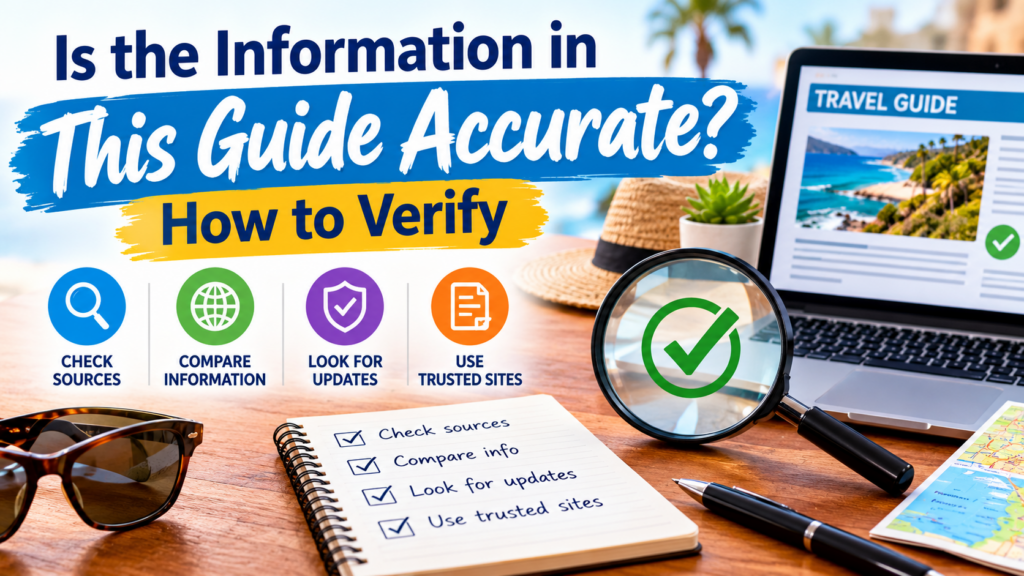
Most competitors stop there and hand you a vague list of signals. That is not enough when you are about to put a nonrefundable hotel night or a timed event ticket behind a detail you have not confirmed. So instead of a loose checklist, score the source. Give each signal below one point. A source that scores 6 or higher is strong enough to plan around. A source that scores 3 to 5 is a lead, not an answer. A source that scores 0 to 2 should not shape your itinerary at all.
| Signal | What to Look For | Point |
|---|---|---|
| Named author | A real byline, not “Staff” or “Admin” | 1 |
| Author connection | A bio showing local residence, beat coverage, or firsthand visits | 1 |
| Identifiable publisher | An About page, a mailing address, a contact method | 1 |
| Update date | A visible “last updated” or “reviewed” date | 1 |
| Primary-source links | Links to official venue, city, or organizer pages | 1 |
| Checkable specifics | Full addresses, phone numbers, named dishes, dated photos | 1 |
| Correction path | A way to report an error that the site acknowledges | 1 |
| Independent reporting | Evidence the site gathered details itself rather than copying | 1 |
Run that score on any page, including ours. It takes about two minutes and it tells you how much verification work you still owe before you commit money.
Check the Author and Publisher
The author and the publisher are not always the same, and both matter. The author is the person who wrote the words. The publisher is the site or company that stands behind them. A strong guide makes both easy to find.
Look for a real byline with a name, not just “Staff.” Then check whether that person has subject-matter expertise on the area. A writer who covers local dining for years will know things a generalist misses. That local knowledge is exactly what you want when you are hunting for authentic Vietnamese or Korean food.
Publisher transparency matters too. Can you find an “About” page? An address? A way to send a correction? Sites that welcome corrections tend to be more careful, because they know readers are watching.
A practical test: pick one specific claim from the page, a restaurant’s hours, a tour’s start time, a rental’s check-in window, and try to trace it back to the business or organizer. If the page gives you a link or a phone number that gets you there, the publisher is doing its job. If the trail dead-ends at the page itself, you have learned something important before you booked anything.
Look for Evidence and Citations
Evidence is what separates a claim from a guess. When a guide says a beach is “family-friendly,” that is an opinion. When it says the parking lot fills by 10 a.m. on summer weekends, that is a testable claim. Good guides give you the second kind.
Citations do not have to be academic. A link to the park’s official page, a city website, or a business’s own site is enough. What matters is that the claim traces back to something you can check.
Watch for these evidence signals:
- Links to official sources, like city or park websites
- Specific numbers instead of vague praise
- Dates attached to time-sensitive claims
- Named places you can look up yourself
When a guide offers none of this, slow down. It may still be right. But you cannot confirm it, and that is the whole point of fact-checking.
Score every source before you trust it. Authorship, publisher transparency, evidence, and a correction path are worth one point each. Six or more means plan around it; three or fewer means keep looking.
official visitor information and local government pages you can use to confirm venue details
Verify Information With Multiple Sources
Cross-checking is the fastest way to confirm a fact. The rule is simple: never trust a single source for anything that matters to your trip. Find the same detail in two or three independent places. If they agree, you can plan around it. If they disagree, dig deeper before you commit.
Independence is the key word. Three sites that all copied the same outdated listing are really one source wearing three hats. You want sources that gathered the information on their own.
Good independent sources include:
- The business’s own website or social page
- The local government or parks department site
- A recent review with a photo and date
- A phone call to the place itself
That last one still works, and it beats everything else for hours, closures, and reservations.
Cross-Checking Facts and Figures
Numbers deserve extra care. Hours, addresses, and dates are the details most likely to be wrong, because they change the most often. A guide can be perfectly written and still list last season’s schedule.
Here is a simple cross-check method for any fact:
- Find the claim in the guide.
- Search for the same claim on the official source.
- Look for one more independent mention.
- Note the date on each source.
- Trust the most recent, most official one.
If the guide says a pool opens at 9 a.m. and the city page says 10 a.m., believe the city page. Official sources set the rules. Guides only report them.
When two sources disagree, call the venue directly. A 60-second phone call settles more disputes than an hour of searching, especially for seasonal hours.
Your Fact-Checking Checklist for Any Guide
A repeatable checklist turns fact-checking into a habit instead of a chore. Run these steps on any guide, including ours, before you build your itinerary around it. The whole process takes a few minutes per listing.
Work through this list for each place you plan to visit:
- Confirm the name and address on the official site
- Check hours for the exact day you will go
- Verify seasonal closures or holiday schedules
- Confirm parking details and any fees on the official page
- Check the guide’s last updated date
- Look for a recent photo or review with a date
- Call ahead for reservations or group visits
- Save the official link for the day of your trip
The checklist works for anything: a park, a restaurant, a skating rink, a golf course. It also protects you from the most common travel frustration, which is arriving somewhere that is closed.
Skipping the hours check is the mistake that ruins the most trip days. A venue that closes one day a week will not announce it at the door. Confirm the day before you go.
Spotting Misinformation and Red Flags
Misinformation in travel content is rarely malicious. Most of it is old, copied, or written by someone who never visited. But the effect is the same: you get bad directions and wasted time. Learning the red flags helps you spot weak content before it costs you.
Most guides give you a list and stop. The useful part is knowing what to do with the list. Treat red flags as a count, not a feeling. One flag is a caution. Two flags means verify every detail you plan to act on. Three or more means find another source before you book anything.
Watch for these warning signs:
- No author and no date anywhere on the page
- Vague praise with no specifics (“the best food in the area”)
- Copied text that appears word-for-word on other sites
- Broken links to official sources
- Prices or hours with no source and no date
- Stock photos instead of real ones of the place
- Pressure language pushing you to book right now
- A booking button that appears before any verifiable detail about the venue
That last one matters more than it sounds. A page that wants your reservation before it tells you where the property is, when the tour departs, or what the cancellation terms are is optimizing for the sale, not for your trip. Legitimate hotel, vacation rental, tour, and event listings put the logistics where you can see them before checkout.
A Worked Example
Suppose a page describes a weekend food tour. It names a neighborhood, lists four stops, and says the tour runs every Saturday at 11 a.m. It has no author, no update date, and the photos are polished stock images of dishes that do not match the named restaurants.
That is three flags: no author, no date, and mismatched photos. Under the count rule, you stop and find another source. You search the tour operator’s own site, confirm the Saturday start time and the meeting point, and check whether the stops are still open. If the operator’s page confirms everything, the original guide was probably just stale. If the operator’s page contradicts it, you just avoided showing up at the wrong place at the wrong time.
The Subtler Problem
There is also a quieter failure mode: content written for search engines rather than travelers. It reads smoothly but says nothing checkable. If a page never names a street, a neighborhood, or a specific dish, it probably was not written by someone who has been there.
You can test this in about a minute. Pick the single most important detail for your plan, the tour departure point, the rental’s check-in instructions, the event’s gate time, and try to confirm it somewhere other than the page you are reading. If you cannot, the page has not earned your booking.
A booking prompt that appears before any verifiable venue detail is a red flag on its own. Confirm the logistics first, then decide whether to reserve.
How to recognize and report misleading or deceptive content online
How to Verify a Specific Claim, Statistic, Image, or Quote
Single facts need single checks. When one detail decides your plan, verify it on its own. Do not rely on the overall feel of a guide. Test the exact claim.
Use this approach by claim type:
| Claim Type | How to Verify It | Best Source |
|---|---|---|
| Hours or address | Search the official listing | Business or city site |
| Statistic or figure | Trace it to the original report | The source that published it |
| Image | Reverse image search | The original photographer or site |
| Quote | Find the full original text | The publication that ran it |
| Event date | Check the organizer’s page | Event or venue site |
For statistics, follow the number back to where it started. Many pages cite a figure without linking it. If you cannot find the original, treat the number as unconfirmed and leave it out of your planning.
Images deserve their own check. A photo can be real but old, or real but from somewhere else. A reverse image search shows where else it appears. If the same photo shows up for five different places, it is stock, not proof.
Quotes are the easiest to check and the most often faked. Search the exact words in quotation marks. If the phrase only appears on one site, be skeptical. Real quotes show up in the original interview or publication.
Reverse image search is the fastest way to catch a fake or misplaced photo. Drag the image into the search bar and see where it really comes from.
AI-Generated Content and Synthetic Media
AI has made it cheap to publish travel content that sounds confident and is completely wrong. A page can describe a restaurant in detail, name a dish, and describe the room, all invented. This is the newest accuracy problem you will face, and it needs its own habits.
The tells are getting harder to spot, but a few still work:
- Generic descriptions that could fit any city
- No real photos, only polished stock or AI images
- Confident tone with zero sources
- Odd details like a street that does not exist
- No author, no date, no contact
- Text that repeats itself in slightly different words
AI images have their own clues. Look at hands, text in signs, and background details. They often look slightly wrong. Reflections and shadows may not line up.
None of this means AI-written content is always false. It means you cannot assume it was checked by a person. Apply the same tests you would use on any guide: find the claim, confirm it on an official source, and trust the source that can prove it.
What to Do When You Find Inaccurate Information
Finding an error is useful, not just annoying. It tells you the source is stale, and it tells you which details to double-check everywhere else. Here is how to respond.
First, do not throw out the whole guide. One wrong hour does not mean every listing is bad. Check the other details you plan to use, then decide how much to trust the rest.
Second, report the error if the site makes it easy. A quick correction note helps the next traveler and often gets the page fixed. Good publishers welcome this.
Third, adjust your plan around the confirmed facts. Build your day on the details you verified on official sources, and keep the unverified ones as backup options.
Finally, favor sources that show their work. A guide that lists its sources, dates its updates, and invites corrections is doing the hard part for you. That is the standard we aim for at Fountain Valley as we build out our local guide. When you book a stay or plan a day with us, you can check our details against the official sources yourself, and we would rather you did.
Frequently Asked Questions
How can you tell if the information in a guide is accurate?
Check the author’s credentials, look for citations to primary sources, and confirm the publication or last-updated date. Then verify key claims with at least two independent sources, such as a government website and a reputable news outlet. If the guide lists specific hours, prices, or policies, cross-check them directly with the business or agency. A guide that shows its sources and dates is generally more trustworthy than one that does not.
What is the most reliable source of information for travel planning?
Government websites, official tourism boards, and established news organizations are usually the most reliable for practical travel details like entry requirements, safety advisories, and transportation. For health information, the CDC and state health departments are authoritative. For local businesses, call or check their official website. No single source is perfect, so verify information with multiple sources before you rely on it.
How do you verify a claim using more than one source?
First, identify the exact claim (for example, a museum is free on Tuesdays). Then search for that claim on at least two independent sites: the organization’s own website and a separate reputable source like a local news article or a government page. If both agree, the claim is likely accurate. If they conflict, go with the more authoritative and recently updated source, or contact the organization directly.
What should you do if a guide contains outdated information?
Do not rely on the outdated detail. Instead, check the official website or call the business or agency to get current information. If you are using a printed guide, look for a newer edition or the publisher’s website for updates. You can also report the error to the guide’s publisher so they can correct it. Always confirm time-sensitive details like hours, prices, and closures close to your travel date.
Planning a trip means juggling a lot of details, and you should not have to guess which ones are right. Fountain Valley is building a local guide with clear sources, dated updates, and a way for you to check every listing. Our team focuses on the details that matter for a real trip: where to stay, what to see, and how to spend your days well. Get started with Fountain Valley and plan a trip you can actually trust.